
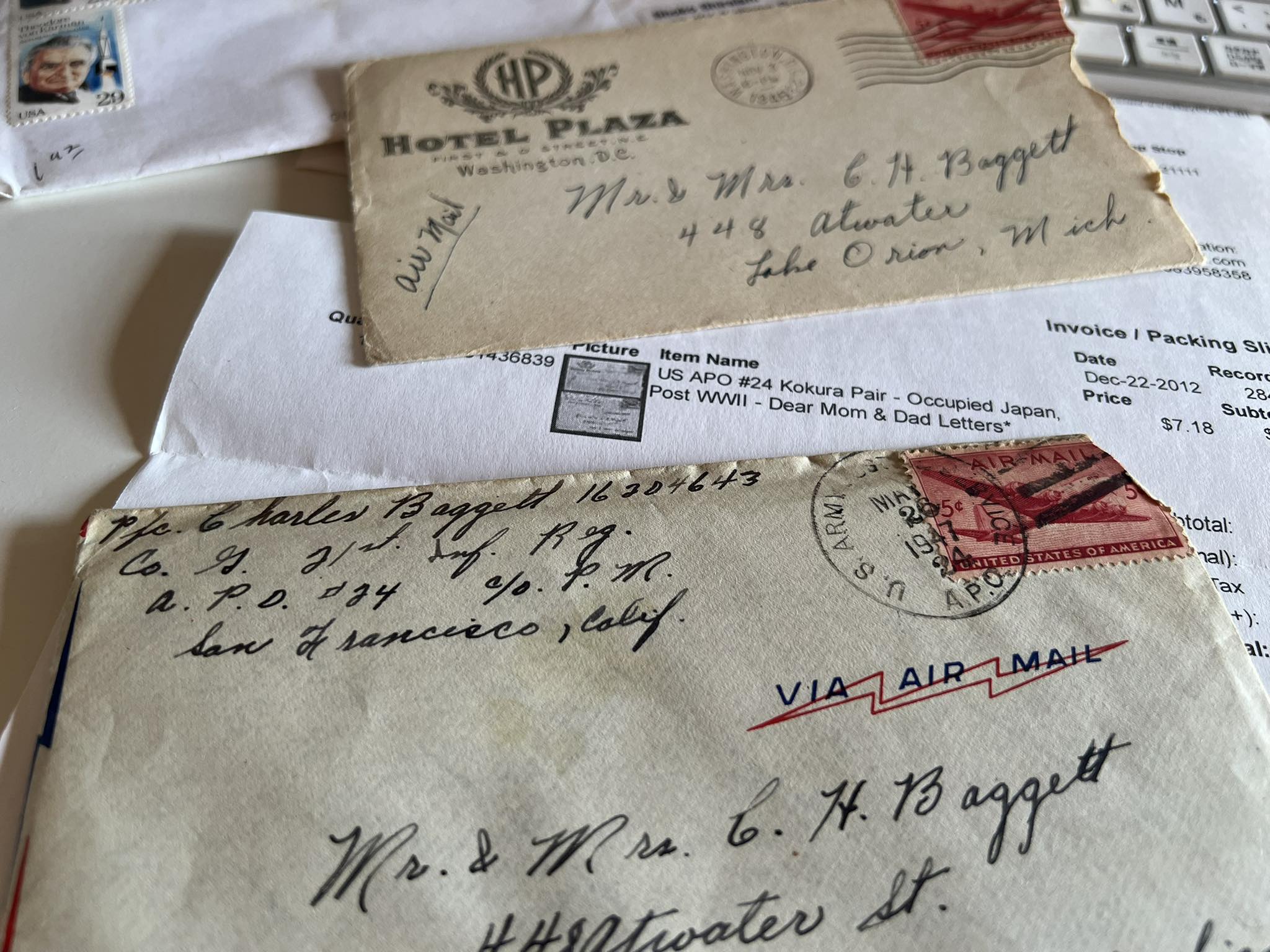
Yesterday, I was looking for my cats Doris (Day) and Glenn (Miller), which I had in the late 1980s, but I couldn’t find them. I then opened the boxes in a closet. Then I found these letters, which I had forgotten where I had put them
In 2012, when I was exploring the post-WWII occupied time of KOKURA, I found letters “US APO #24 Kokura Pair-Occupied Japan, Post WWII – Dear Mom & Dad Letters.” on eBay and I bought them.
Sender’s name is “Charles Baggett”. The letters were written in cursive. The letter was written in cursive. Its contents were nothing special—a young man writing daily matters, the weather, to his Mom and Dad—and proved of little use for my research at the time.
The letters reminded me of the song “P.S. I Love You”.
On a whim, I entered the recipient’s address into Google. I found a charming old house on Google Maps. According to a real estate website, the house was built in 1890.
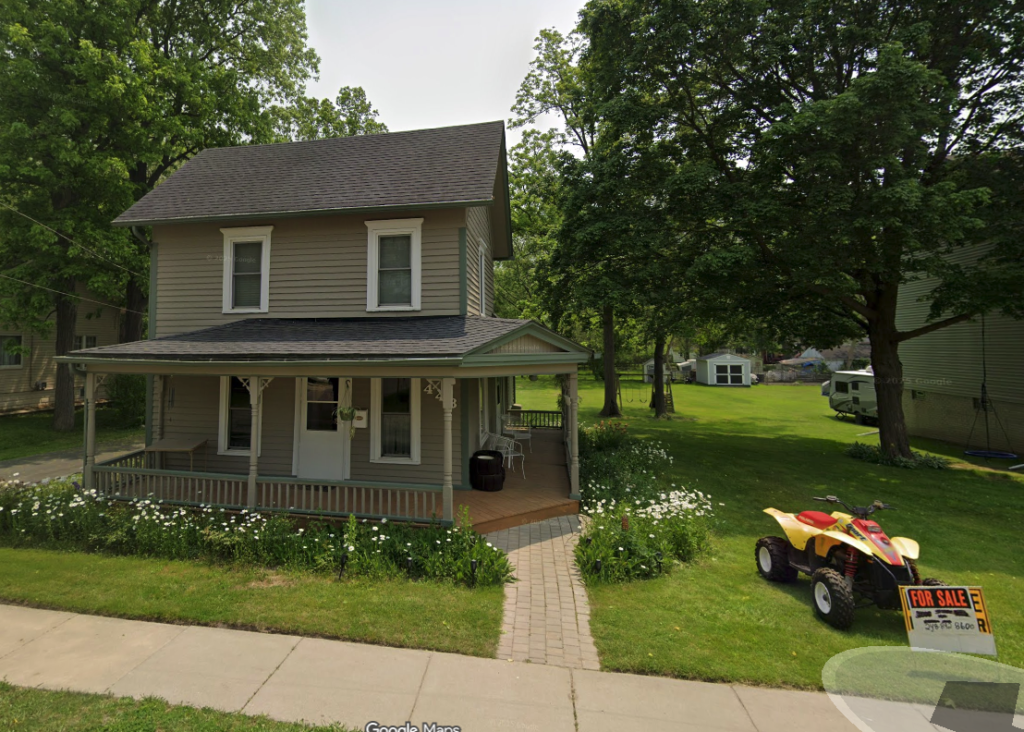
The boy rose, and maybe he was born in the house, then went to the war.
One letter was Nov 3rd in 1946, another is May 26th in 1947. I prayed he wouldn’t die in the Korean War.
The words of the letters didn’t say his camp was KOKURA. How can I know? I wondered and put “US APO #24 Kokura” into a search bar. I found this article below.
Luck of Kokura: The Japanese City That Avoided Atomic Bombing – Twice
Then I clicked the link on the words “other influences.”. The article said,
–A few weeks ago, there was a story carried by Japanese newspapers along these lines:
As the 69th anniversary of the Nagasaki atomic bombing approaches, a former mill worker in the present-day city of Kitakyushu, Fukuoka Prefecture, spoke about his untold story on how he burned coal tar to block the view of U.S. aircraft as they were about to drop the A-bomb on the city. … Of the three workers, Oita resident Satoru Miyashiro, 85, who worked at a can factory in the steel mill at around the end of the war said he burned coal tar to lay a smoke screen on Aug. 9, 1945. … Miyashiro said about two days before the Nagasaki attack Yawata steel workers learned that Hiroshima had been wiped out by the “new bomb” from their colleagues who had come back to Yawata via Hiroshima. He thought the next target would be his city as there were arms factories located in the area.
I will write about the atomic bombs another essay, so I will go back to letters and “Mr.Baggett” and his family.
Then… I found this page.

Barbara Baggett
Barbara Adelle Wiseman Baggett; born March 23, 1929 at the University of Michigan Hospital in Ann Arbor, Michigan. Barbara is the daughter of the late Professor Homer J. Wiseman Sr. and Daisy M. Wiseman; wife of the late Charles H. Baggett Jr. whom she married on June 12, 1954 and spent 50 years of marriage together; mother of David (Linda) Baggett of Oxford, MI and Cynthia Baggett Van Wey of Ohio; and grandmother of Matthew and Michael Baggett and James Van Wey. Barbara is also survived by her sisters in law Carolyn Baggett and Sharon Baggett; and many nieces, nephews, great nieces and great nephews and cousins. She was preceded death by her brothers Homer (Barbara) Wiseman Jr., Wilfred (Phyllis) Wiseman and Richard (Donna) Wiseman. Barbara graduated from Marywood Academy, Highland Park College, attended Wayne State University and graduated from Mercy Hospital School of Nursing. She was a member of St. Joseph Catholic Church, Our Lady of Sodality, The Newman Club and the National League of Nursing. Private funeral services were conducted by Sparks-Griffin Funeral Home, Lake Orion.
It says “wife of the late Charles H. Baggett Jr. whom she married on June 12, 1954 and spent 50 years of marriage together; “
After leaving Japan, he met Barbra, and they spent the next 50 years together. My heart filled with warmth when I learned that he had survived the wars and built a family.
After writing this post, I learned more about the “21st Infantry Regiment“.
The 21st Infantry Regiment was assigned on paper to the 24th Infantry Division on 26 August 1941. After World War II, the regiment was stationed at Camp Wood near Kumamoto. It was the farthest post in Japan, and the poorest class of soldiers were stationed there. Mr. Charles Baggett Jr. was a young soldier who was not stationed in Kokura. The soldiers at Camp Wood were the first unit sent to Korea.
Wiki said,
On 24 June 1950, the North Korean People’s Army (KPA) invaded South Korea, beginning the Korean War. On 30 June, President Harry Truman decided to defend South Korea with American ground forces. The Pentagon selected the 24th Division to deploy first, with the 21st regiment being the first to go to South Korea. Due to a shortage of air transport, the regiment could only airlift a force comprising less than a battalion to Pusan. The remainder of the regiment and the rest of the division were to follow by sea transport. 1st Battalion, led by Lieutenant Colonel Charles Smith, became the advance force. It was designated as Task Force Smith and comprised B & C Companies, half of Headquarters Company, two 75mm M20 recoilless rifles, four M2 4.2 inch mortars and a battery of 105 mm howitzers.[2]
For more information on the actions of Task Force Smith, see Battle of Osan.
Please read about Task Force Smith on the Battle of Osan page. We can see what they faced during the Korean War as the first sent unit.
At times, we are aware that we do not know the past. “The first units of the 24th Infantry Division left Itazuke Air Base in Japan on June 30.” The former Itazuke Aire Base is now Fukuoka Airport, which I have used many times. Our generation, which was born in the 1960s and 1970s, already doesn’t know the history of the Airport.
Friends of Mr. Baggett may have died after a few days they left the Itazuke. If I imagine, I feel sadness and pain.
So, then I will tell them “I Remember You”.